
If you’ve ever tried to price something you know how to do, and instinctively landed on “I guess I could charge a few pounds,” because that’s what a book costs, this is worth thinking about before you set a price on anything.
Different formats, different jobs
My first property book did well. It gave me a bit of PR, a flagship title, something to point to. It also taught me something useful about pricing, though it took me a while to see it: a book and a manual aren’t competing products, they’re doing two different jobs, and people price them accordingly in their own heads before you’ve said a word.
So what is the difference? Well, a book is a book, whether it’s an eBook, paperback or hardcover, and in that order they get progressively more expensive (usually).
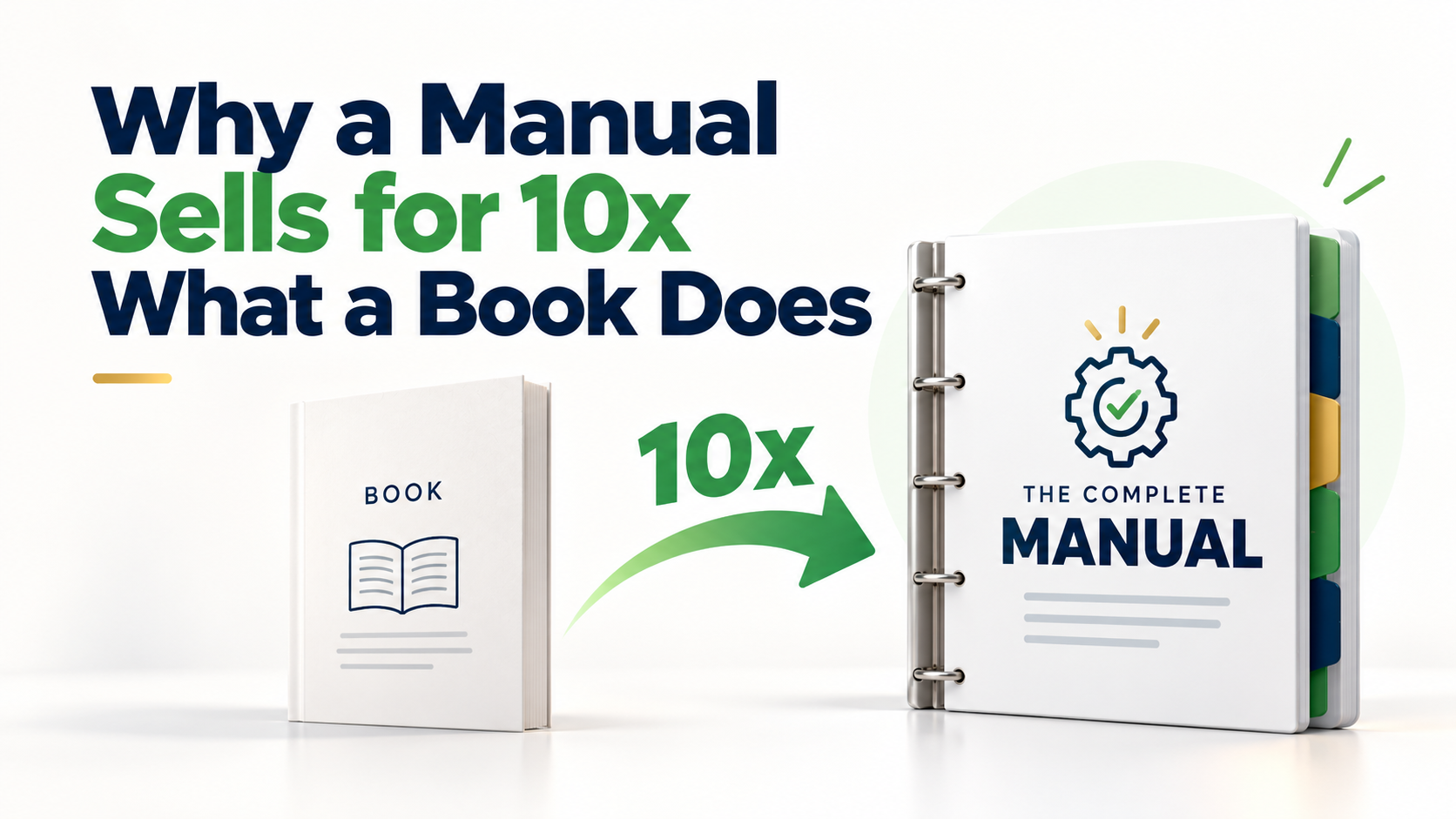
A “Manual” is different again. It can be exactly the same content, but it’s packaged — often in a folder, my favourite format is a hardcover four-ring binder — and it says to the recipient “serious study material.” How it’s treated by the buyer is different too: a book is something someone buys expecting a good read. A manual is something they buy expecting to actually study and use, step by step, to get a result. Neither is worth more than the other in terms of what’s inside — the value can be the same knowledge either way — but people’s willingness to pay reflects the outcome they think the format is going to create for them.
The same content, a different container
By 2004 I’d written a second, more detailed product, and this time, instead of printing it as a paperback, I put it out in a four-ring binder as a Manual. Not because it was cheaper to produce, but because it wasn’t a book any more — it was a Manual, and that let me price it higher. Much higher.
There’s a name for the effect a fat ring binder has when it lands on someone’s desk or doormat: the thud factor. But the real reason it worked wasn’t the weight, it was the category people put it in the moment they saw it. Same knowledge, same person, five to ten times the price, just by presenting it as the tool it actually was rather than a book to read on the sofa.
Setting expectations properly is what makes it work
I made sure my website said exactly what people were getting — produced as a Manual, in a four-ring binder — before anyone bought it. In twenty years of selling it that way, I never had a single complaint. Nobody felt misled, because nobody was. They knew what was coming, and a manual was exactly what they wanted.
That’s the part worth taking seriously if you try this yourself: repackaging only works honestly. You’re not disguising one format as another. You’re matching the container to what the reader’s actually going to do with it, and pricing it for that job.
Where I left money on the table
I launched that manual at £29.97 in 2004, and here’s where I got it wrong: I never raised the price properly after that. Cheaper competitors turned up years later, and rather than increasing my price and trusting the higher perceived value I’d built, I let it sit. It should have gone up steadily the whole way through, and it didn’t, because at the time it wasn’t my main focus and I couldn’t be bothered to fight for it.
That’s the lesson inside the lesson: getting the packaging right is what earns you the higher price. Actually charging it, and keeping charging it, still takes a bit of nerve.
The takeaway
Before you price anything you know, ask what job the reader actually needs it to do — a casual read to entertain them, or a working tool they’ll use step by step to get a specific result. Then price it for that job, whatever the format, and be honest with people about what they’re getting. Just don’t do what I did and go quiet on the price once you’ve earned the right to ask for more.