
You’ll often hear it said: build an audience first, before you start promoting your knowledge. It’s true, and it’s also useless advice the moment you’re actually starting from zero. Nobody ever explains what to do on the day you decide you do have something worth saying and nobody to say it to.
Here’s what I actually did, long before anyone had heard of me.
A book with nowhere to go
I’d written a book about property investing. It was a labour of love that took me the best part of a year — nowadays it’d be much quicker — half an hour here and there around a day job, mainly at lunchtime in the café at a local department store. Once it was done, I was elated, but I had no idea what to do with it. I didn’t have a following. I didn’t have a mailing list. I didn’t have a plan. But I did have the desire to make something happen.
Then a strange thing happened. Not long after I’d finished it, and it was safely backed up on a floppy disk (are you old enough to remember those?), I was reading the trade magazine surveyors and other property people actually read. Tucked in the classified section was an advert: wanted, a property journalist to write property articles.
I wasn’t a property journalist. But I really believe in “if you don’t ask, you don’t get,” so I answered it anyway.
The trick: someone else already had the readers
The advert had been placed by a man who ran a subscription newsletter about property auctions — the kind of thing people paid a monthly fee to receive, delivered by post, back in the early 2000s. He’d been writing the content almost single-handedly for years, and much as he loved it, it was hard work month after month, and he wanted his life back. So he needed someone to write the articles. I needed readers to buy my newly written book. Between us, that was the whole deal.
Instead of trying to build my own audience from a standing start, I plugged into one that already existed. He had subscribers who already cared about exactly what I knew. I didn’t need to find them — I just needed to write for the person who already had them.
I agreed to write a number of articles each month, and in return he paid me per article and let me put a small advert for my own book at the bottom of every one. Not a big pitch — just a couple of lines, something like, “if you liked this article, I’ve also got a book you can buy.”
One piece of writing, two results
Every month, two things happened at once. I got paid for the article. And a few people, reading it, sent off for the book. Cheques arrived in the post for both, the newsletter payment and separately the book orders, and neither one depended on me having my own platform. Both were riding on somebody else’s.
And every one of those book orders came with a name and an address, which is exactly how a mailing list starts, almost as a side effect of doing paid work for somebody else.
How this actually translates today
I know this all reads like ancient history, but the principle is sound and still holds true today.
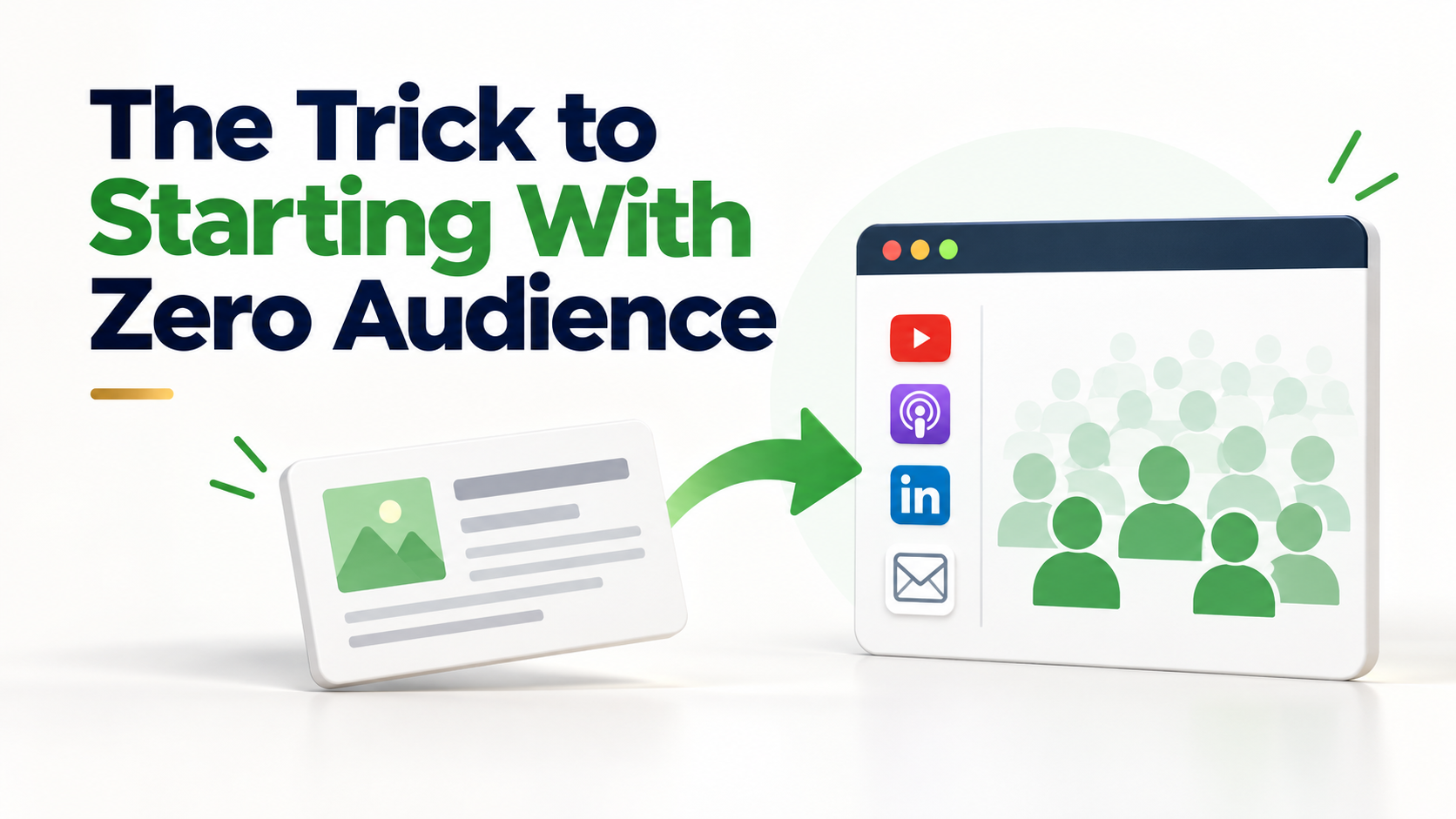
You don’t need a newsletter that arrives by post and a classified ad in a trade magazine. You need the modern version of the same trick: find whoever already has the audience you’d otherwise spend years building. That might be a newsletter in your space that takes guest contributions, a podcast that has guests on, or a LinkedIn creator or niche Facebook group already talking to the people you’d want to reach. The offer’s the same one I made without realising it was a strategy: I’ll do the work, you’ve already got the readers, and if there’s room for a small line back to what I’m building, I’ll take it.
And of course, over time you can develop your own LinkedIn presence, your own Facebook group, your own website offering a free lead magnet (more on that in a future post), so the day will come when you have your own list and don’t rely on someone else’s. But you don’t have to wait for that moment. There are ways to piggy-back, ethically and with consent, on the work of others who already have contact with the people you need to reach.
Where this goes next
This is the second piece in a small pattern: the first was about not needing to be the expert to start. This one is about not needing an audience to start either. Both doubts stop people at the same moment, before they’ve done anything, and both turn out to be wrong for the same reason: you don’t need to have arrived. You need to be willing to plug into what already exists.